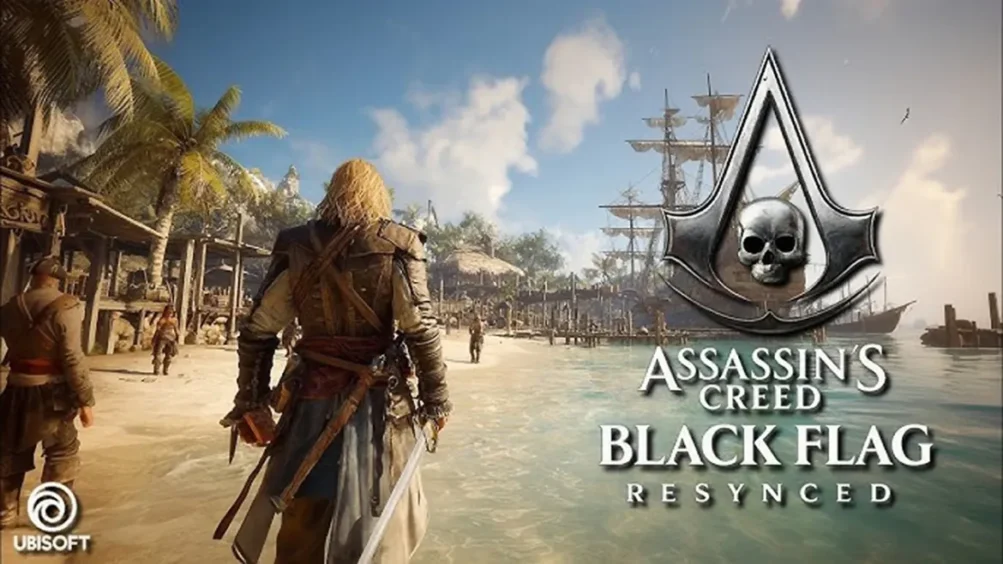
If you were a gamer in 2013, you remember exactly what it felt like to sail the Jackdaw across an open Caribbean for the first time. Assassin’s Creed IV: Black Flag was something special a pirate adventure that somehow felt more alive than almost anything else Ubisoft had made before it. Edward Kenway was rough, funny, and genuinely interesting in a way that protagonist-driven open-world games rarely manage. Now, thirteen years later, Ubisoft is bringing him back not with a fresh coat of paint, but with a full ground-up rebuild called Assassin’s Creed Black Flag Resynced.
This is one of the most anticipated game releases of 2026, and for good reason. If you want every confirmed detail about what Resynced changes, what it keeps, how it plays, whether your PC can run it, and which edition is worth your money this is the only guide you need.
What Exactly Is Black Flag Resynced — A Remake or a Remaster?
This question has been doing the rounds on gaming forums ever since the project was first rumored, so let’s clear it up immediately. Assassin’s Creed Black Flag Resynced is a full remake, not a remaster. Ubisoft has been clear on this point, and the distinction matters enormously. The game contains zero code from the original 2013 title. It was rebuilt entirely from scratch inside the latest version of Ubisoft’s Anvil engine the same engine that powered Assassin’s Creed Shadows in 2025.
A remaster takes existing assets, upscales textures, maybe fixes some bugs, and calls it a day. What Ubisoft Singapore has done with Resynced is far more ambitious. Every character model, every environment, every animation, every system — rebuilt. The Caribbean you are about to sail into does not share a single line of code with the one you explored over a decade ago. That is a significant undertaking, and it puts Resynced in a different category entirely from the kinds of re-releases that have saturated the market in recent years.
Ubisoft Singapore led the project, which feels fitting. The Singapore studio has deep roots in the Assassin’s Creed franchise’s naval heritage, having contributed substantially to the original Black Flag’s seafaring systems and later to Assassin’s Creed Rogue. Additional development support came from Ubisoft Barcelona, Ubisoft Chengdu, and Ubisoft Montpellier.
Release Date and Platforms
Assassin’s Creed Black Flag Resynced launches on July 9, 2026, on PlayStation 5, Xbox Series X/S, and PC via Windows. On PC, you can pick it up through the Ubisoft Store, Steam, and the Epic Games Store. It will also be available through streaming services GeForce Now and Blacknut at launch, and it lands day one on Ubisoft+ for subscribers.
If you were hoping for a PS4 or Xbox One version, that is not happening. This is strictly a ninth-generation and PC release, and given the technical demands of the Anvil engine’s Micropolygon geometry system and its ray-tracing pipeline, that makes complete sense. This game was built for current hardware.
The Story: What’s New, What’s Been Changed, and What’s Gone
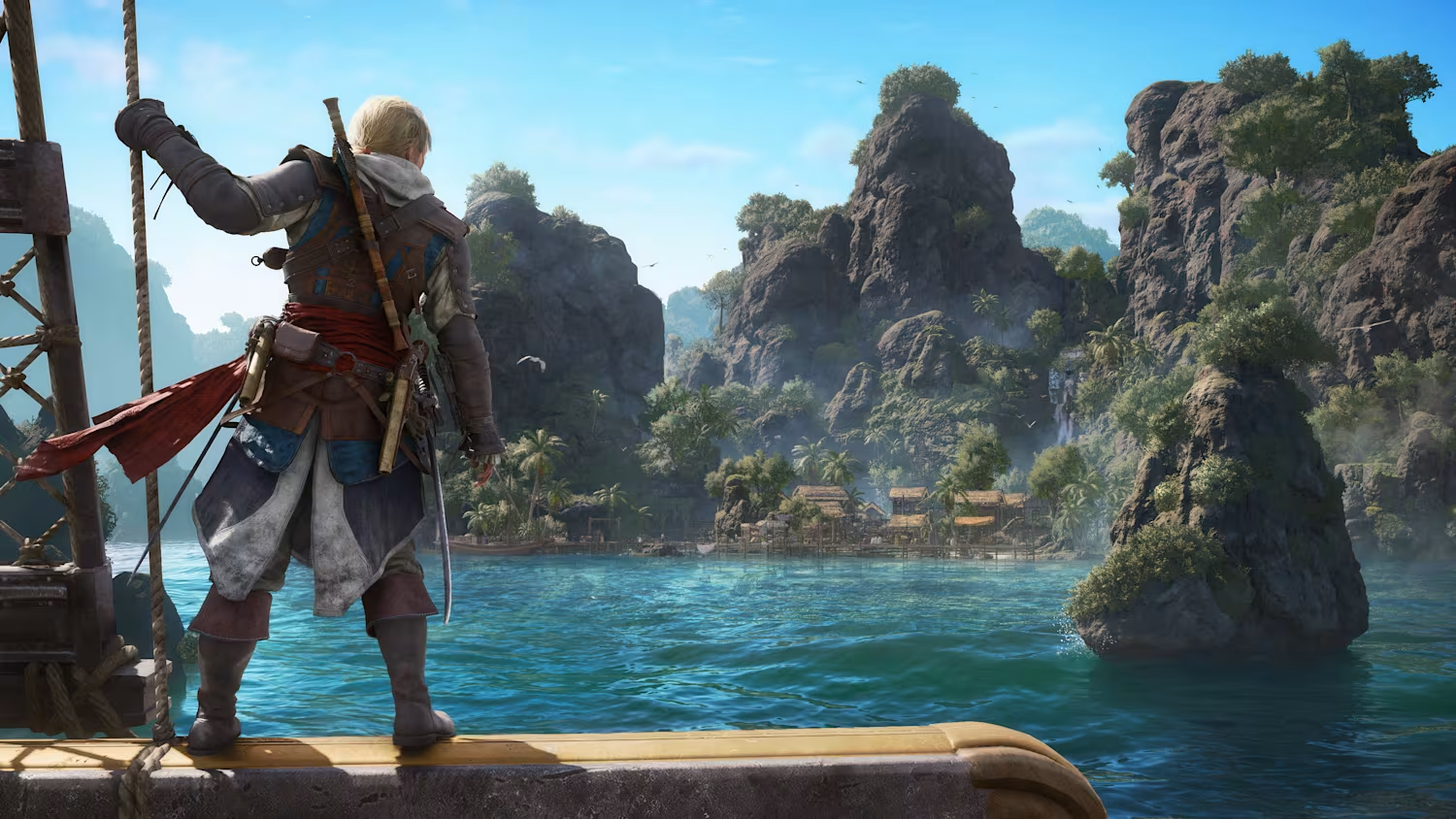
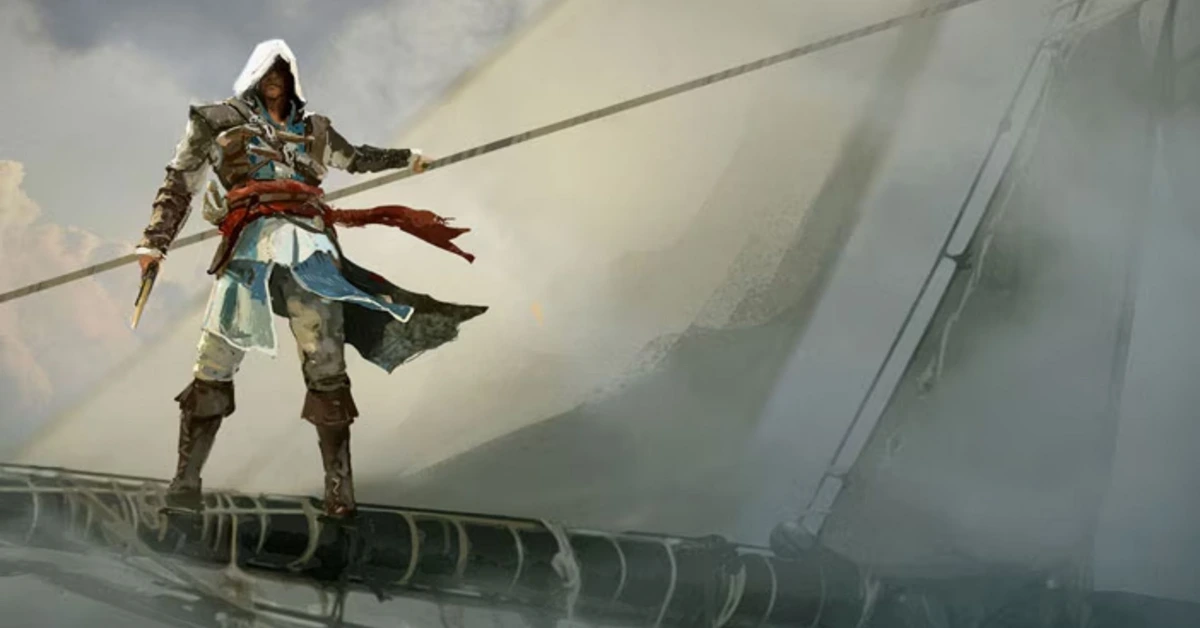
The core of Black Flag’s story remains intact Edward Kenway is still a Welsh privateer-turned-pirate carving his legend across the Caribbean, caught between the Assassin Brotherhood and the Templar Order. The themes that made the original work are all here, but Ubisoft and returning lead scriptwriter Darby McDevitt have used the remake as an opportunity to go deeper.
McDevitt wrote the original Black Flag back in 2013 and came back specifically for Resynced to write two new scenes and revise an existing one. One of the most meaningful additions is a new scene between Edward and his wife Caroline, which gives his personal motivations more emotional grounding early in the story. The theme of greed always central to Edward’s arc has been expanded throughout. His journey from opportunistic pirate to something more principled feels more earned in Resynced because the writing gives his flaws more room to breathe.
Blackbeard and Stede Bonnet, two of the most memorable supporting characters from the original, now receive proper expanded arcs rather than feeling like historical cameos. Three new officer characters are introduced as part of the main narrative, joining the Jackdaw during the story itself. These additions slot into the existing structure without feeling forced.
On the other hand, some things have been cut. The Freedom Cry DLC Adéwalé’s standalone story is not included in Resynced. The team’s stated reason was a desire to keep the game fully focused on Edward’s Caribbean adventure, and while Freedom Cry was a genuinely powerful piece of storytelling, that is a call that makes sense for the cohesion of the main experience. The modern-day sequences set inside Abstergo Entertainment’s offices from the 2013 original have also been removed. Creative director Jean Guesdon explained that those sequences made sense in 2013, when the franchise was in a specific moment of transition, but they no longer reflect where Assassin’s Creed is today. In their place are new narrative sequences that explore Edward’s memories through a lens described as “What if?” scenarios — more story-driven than the Rift missions in Shadows, and focused on deepening your understanding of Kenway rather than breaking from the Caribbean setting.
Guesdon described Resynced as “a game full of light” set “under the bright Caribbean sky,” with a strong sense of escapism at its heart. After years of dark, weighty, politically complex Assassin’s Creed entries, that sounds like exactly the right energy.
Gameplay Changes: Familiar, But Meaningfully Different
Ubisoft made a deliberate choice with Resynced to position it as a pure action-adventure game rather than leaning into the RPG direction that dominated entries like Odyssey and Valhalla. There are no numerical gear levels, no branching dialogue trees that alter the story, no skill trees with hundreds of nodes. Edward is Edward. The game trusts its protagonist and its world to do the heavy lifting.
Movement Feels Brand New
Parkour in Resynced builds directly on the animation systems developed for Assassin’s Creed Shadows. Edward’s classic moves are all there he climbs, leaps, and swings through jungle canopies and colonial port towns just like you remember but the transitions between those moves are dramatically smoother. Landing animations have been reworked so Edward recovers from drops quickly rather than slamming into the ground and stumbling. The overall effect is a character who flows through the environment rather than stopping and starting through it. A manual crouch option has been added for the first time, giving you far more deliberate control during stealth approaches.
Combat Has Been Rebuilt Around Timing, Not Button Mashing
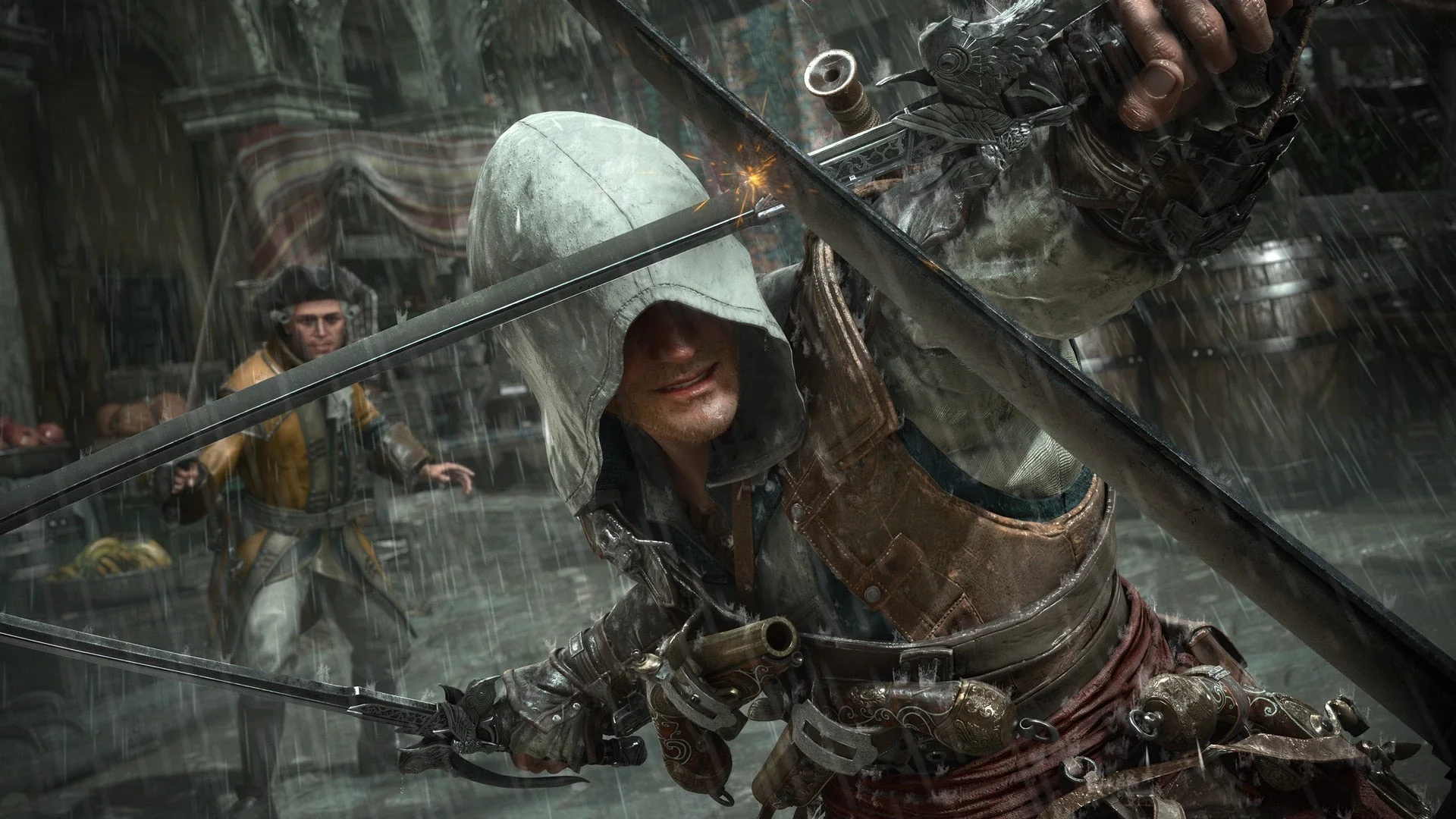
The combat overhaul is probably the biggest mechanical departure from the original. The old Black Flag combat system was effective but forgiving you could chain kills fluidly with minimal thought once you had the rhythm down. Resynced tightens that considerably. Parries are now the core defensive mechanic, and they require more precision than the original’s generous timing windows. Combo chains are shorter, and the overall feel is a system that demands you pay attention rather than coast through encounters.
Swords remain Edward’s primary weapon, and the Hidden Blade returns but it has been restricted to stealth kills and contextual assassinations only. You cannot pull it out mid-fight against alerted enemies, which reinforces both the character’s identity and the game’s stealth-forward design. This is the right call. The Hidden Blade as a main combat tool always undermined the mystique of the weapon, and limiting it to its intended purpose makes those stealth kills feel weightier.
One of the more creative additions to combat is a diegetic feedback system built into enemy animations. When you break an enemy’s defense, their hat or headpiece physically falls off a visible, readable cue that your attacks are working. If you play with minimal HUD, you can read the entire state of a fight through enemy body language and animation alone. It is a small detail, but it speaks to the level of craft being applied to systems that could easily have been left unchanged.
Tailing Missions Are No Longer a Nightmare
Anyone who played the original Black Flag remembers the frustration of tailing and eavesdropping missions where a single moment of detection reset your progress entirely. Ubisoft has reworked both mission types so that getting spotted no longer automatically fails the mission. You can recover. You can find another angle. This single change will save players enormous amounts of frustration, and it brings the design philosophy in line with how modern stealth games handle detection. The trade-off is that the ability to replay older missions has been removed once you are past something, you are past it. The game is pushing you forward.
Naval Combat and the Jackdaw
The Jackdaw and the open-sea gameplay loop were the heartbeat of the original Black Flag, and Resynced treats them with the respect they deserve. Naval combat returns with the same foundational design cannon volleys, boarding sequences, ship positioning but the systems around it have grown. You can now recruit officers for the Jackdaw, adding a crew management dimension to the experience. Ship customization options have been expanded meaningfully. Dynamic weather, powered by the Anvil engine’s Atmos system, now influences how your ship actually handles rather than just serving as a visual backdrop. Sailing into a storm now has mechanical consequences.
Underwater exploration, which was a standout element of the original, has been expanded with new areas and content. Water simulation has been reworked entirely to make sailing feel more physically convincing at a technical level.
New sea shanties have been recorded and added a feature that is bound to delight anyone who spent hours collecting them in 2013. A photo mode is included. And one small quality-of-life improvement that will be felt constantly: loading screens when anchoring at major cities have been removed. The world just loads. No interruption.
The Technology Behind It All
The visual upgrade from 2013’s Black Flag to Resynced is, predictably, enormous but the interesting story is in how that upgrade was achieved rather than just how dramatic it looks.
The Anvil engine’s Micropolygon system handles geometry in a way similar to Nanite in Unreal Engine 5. Artists build high-detail assets once, and the engine manages level-of-detail scaling automatically. The result is environments with consistent geometric fidelity at virtually every draw distance, eliminating the pop-in that was a regular feature of open-world games a decade ago.
Physically Based Rendering, which simulates real material properties like roughness, reflectivity, and depth through parallax occlusion maps, was not widely used in game engines in 2013. In Resynced, every surface in the Caribbean reacts to light with physical accuracy weathered ship timber, sun-bleached sails, rain-soaked cobblestones, and the surface of the ocean all behave like the real materials they represent. Ray-traced Global Illumination is active across all graphics modes on PS5, with ray-traced reflections added in Fidelity mode. PS5 Pro owners get additional rendering enhancements and ship with Enhanced PSSR upscaling built in.
Facial animations for Edward and the main cast were captured using modern motion capture technology, and the difference in expressiveness compared to the 2013 originals is significant. Edward in Resynced looks and moves like a character from a current-generation game, which sounds obvious but carries real emotional weight during story sequences.
PC System Requirements: Can Your Rig Handle It?
Before we get into the numbers, two requirements that apply to every tier: the game must be installed on an SSD (hard drives are not supported at any setting), and you need 16 GB of RAM running in dual-channel configuration. You also need 65 GB of storage space free, and either Windows 10 (64-bit) or Windows 11.
The minimum specification targets 1080p at 30 fps on the Low preset with standard ray tracing and a balanced upscaler. At this tier, you need at least an Intel Core i7-8700K or AMD Ryzen 5 3600 on the CPU side, paired with an NVIDIA GeForce GTX 1660 (6 GB), AMD Radeon RX 5500 XT (8 GB), or Intel Arc A580 (8 GB) with Resizable BAR enabled if you are running the Arc card. This is a genuinely accessible minimum spec for a 2026 game with full ray tracing.
The recommended specification steps up to 1080p at 60 fps, asking for an Intel Core i5-10600K or AMD Ryzen 5 3600 CPU alongside an NVIDIA GeForce RTX 3060 (12 GB), AMD Radeon RX 6600 XT (8 GB), or Intel Arc B580 (12 GB) GPU. If you built a mid-range gaming PC in the last three to four years, you are likely in or near this tier.
At the absolute top end 4K, 60 fps, Extreme preset with quality upscaling you need an RTX 4090. That is a demanding ceiling, but it reflects the full weight of the Micropolygon geometry system and the complete ray-tracing pipeline running simultaneously at maximum fidelity. The upside is that the four preset tiers offer solid scalability, and the support for NVIDIA DLSS 4.5, AMD FSR 4, and Intel XeSS 3 upscaling means most mid-range and high-end cards will find a comfortable performance point well above their native rasterization capability.
Dedicated handheld presets are included for devices like the Steam Deck. Cutscene frame rates are uncapped. HDR and ultrawide resolution support are both confirmed.
One internet connection is required at installation. After that, the full main campaign is playable completely offline. Live Animus Hub content the Store, Anomalies, Projects, and Vault requires an ongoing online connection, but none of that touches the core single-player experience.
Editions and Pricing: Which One Should You Buy?
Pre-orders opened on April 23, 2026, across all platforms. Every edition that includes a pre-order bonus grants the Blackbeard’s Crimson Pack an exclusive Edward costume, sword, and pistol.
The Standard Edition at $59.99 covers the base game and is available both digitally and physically. This is the right pick for the majority of players. The game itself is the content.
The Digital Deluxe Edition at $69.99 is digital-only and adds two cosmetic packs on top: the Master Assassin Character Pack, which includes a unique Edward costume, sword, pistol, and trinket with gameplay perks, and the Master Assassin Naval Pack, which brings a sail set, ship’s pet, crew attire, a wheel, figurehead, and hull trim for the Jackdaw. The Deluxe Edition also unlocks on day one through Ubisoft+.
The Collector’s Edition at $199.99 is for the committed. It includes everything in the Deluxe Edition digitally, plus a 31-centimeter Edward Kenway figurine, a steelbook case, a 34-page artbook, a cloth world map poster, a sea shanty music sheet, a leather logbook, and a metal brooch pin. Console copies come with a physical disc; PC buyers get a digital code. It is a genuinely impressive physical package for fans who want something tangible on the shelf.
A physical-only Launch Edition, exclusive to European retailers, includes the base game, the 34-page artbook, and the world map poster at standard pricing.
The Bigger Picture: Why This Remake Matters
Assassin’s Creed Black Flag occupies a unique place in the franchise’s history. It arrived during a period when the series was creatively restless right before the more grounded, RPG-adjacent direction that would define the next decade of entries. Black Flag worked because it was not trying to be everything. It had a clear identity, a charismatic lead, and a setting that felt genuinely alive. The naval gameplay was not just a gimmick layered on top of an Assassin’s Creed game it was integrated into the DNA of the experience in a way that felt intentional.
Resynced is Ubisoft’s opportunity to revisit that identity with the tools of 2026 and the hindsight of knowing why it worked in the first place. The decision to strip out RPG mechanics, bring back the original scriptwriter, expand the story beats that resonated most, and rebuild the technology from the ground up suggests that this is not a cash-in on nostalgia. It looks like a genuine attempt to make the definitive version of one of the best games in the franchise’s history.
Whether it delivers on that promise, we will find out on July 9.
Developer: Ubisoft Singapore (with Ubisoft Barcelona, Ubisoft Chengdu, Ubisoft Montpellier) Publisher: Ubisoft Genre: Action–Adventure Composer: Brian Tyler Platforms: PlayStation 5, Xbox Series X/S, PC (Windows) Release Date: July 9, 2026 Price: From $59.99 (Standard Edition)